
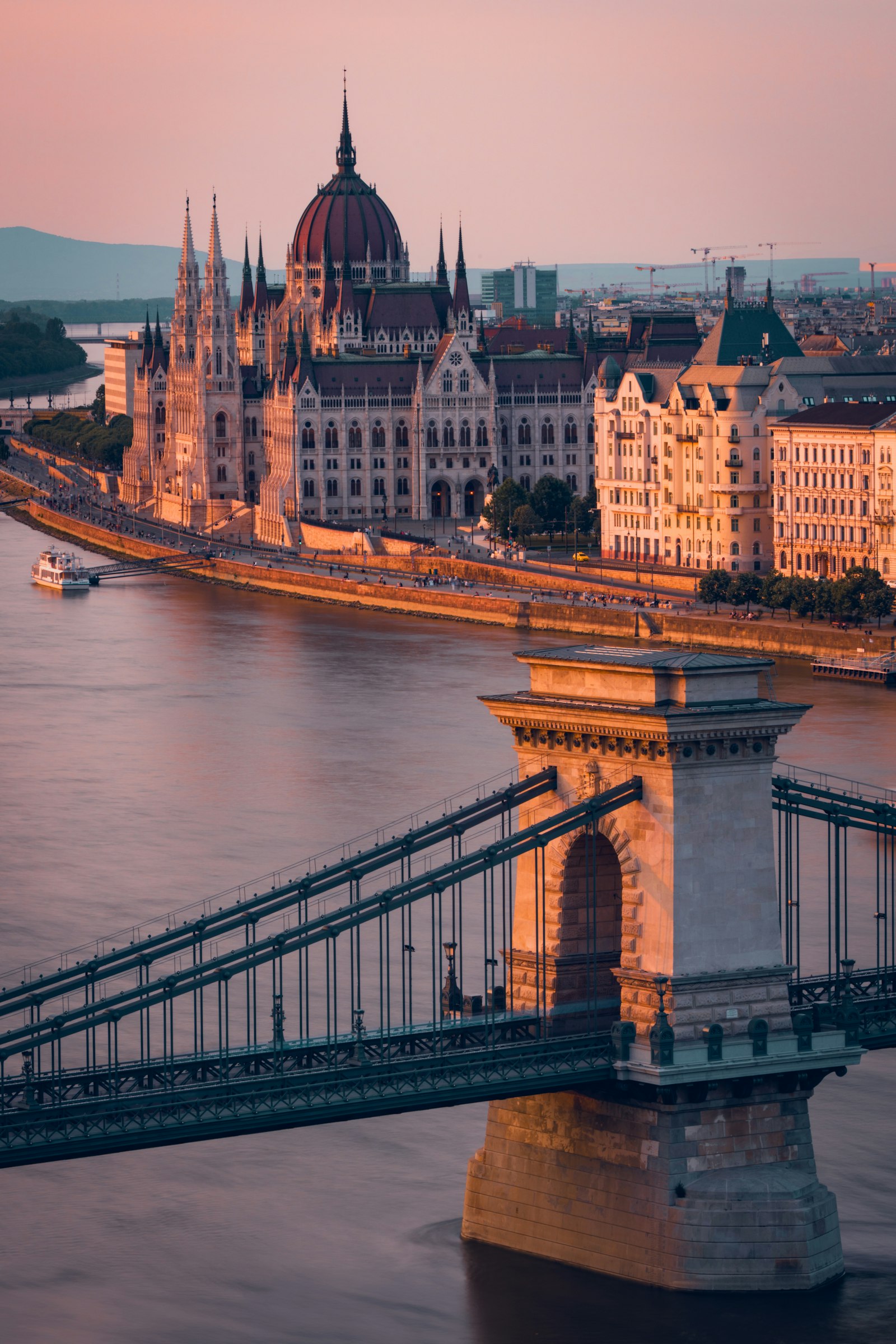
Budapest is Europe’s most underrated digital nomad city. While the nomad crowd flocks to Lisbon and Barcelona, Budapest quietly delivers everything a remote worker needs — fast internet, excellent cafés, a dense walkable city centre, thermal baths, extraordinary architecture, and a cost of living that’s 30–40% lower than Western Europe — all without the price inflation and overcrowding that has hit other popular nomad destinations.
In this guide
The city genuinely looks like a film set: grand 19th-century boulevards, ornate Parliament buildings, thermal baths built into the hillside. And hidden inside all of this are the famous ruin bars of the Jewish Quarter — basement and courtyard venues built into abandoned buildings that have become the social heartbeat of the city, and genuinely one of the best places in Europe to spend an evening as a remote worker.
What Makes a Hotel Nomad-Friendly in Budapest?
Budapest is a compact, flat city — highly walkable in the centre, with an excellent metro and tram network for longer journeys. Location is less critical here than in Lisbon or Bali; most central districts are within easy reach of nomad infrastructure.
What matters most when choosing a hotel:
WiFi reliability — Budapest has strong 4G/5G coverage citywide and most hotels offer decent connections. Mid-range properties specifically mentioning fibre are the safest bet for video call reliability.
Proximity to District VII — The Jewish Quarter is the social and working hub for nomads. Hotels within walking distance give you easy access to the best cafés, coworking spaces, and ruin bars without needing transport every morning.
Heating in winter — Budapest winters are cold (December–February regularly below freezing). Check that your room has proper central heating, not just an electric heater, for winter stays.
Value for money — Budapest’s hotel market offers exceptional value by European standards. Don’t overpay. A $50–70/night hotel in Budapest delivers what a $120+ hotel delivers in Amsterdam or Paris.
Best Areas to Stay in Budapest for Nomads
District VII — Jewish Quarter — the nomad hub
District VII is where Budapest’s nomad and creative community concentrates. The famous ruin bars are here — Szimpla Kert, Fogasház, Instant — alongside excellent cafés, independent restaurants, and an energetic, youthful atmosphere. Hotels in District VII run $35–80/night for mid-range properties, making it both the most interesting and most affordable central district for nomads.
Best for: Nomads who want the full Budapest experience — community, culture, great nightlife, and excellent working infrastructure.
District V — City Centre — polished and central
District V (Belváros) is the formal city centre — the Hungarian Parliament, the Danube promenade, and Váci Street are all here. Hotels are slightly more expensive than District VII but the location is exceptional. Very walkable, close to everything, and slightly quieter in the evenings.
Best for: Shorter stays, comfort-focused nomads, those who want maximum centrality.
District XIII — modern and residential
District XIII is north of the city centre, popular with longer-stay nomads who want a quieter, more residential base with good metro access. More local, less touristy, and noticeably better value for accommodation. A good choice for stays of 2+ weeks.
Best for: Longer stays, budget-conscious nomads, those who prefer a quieter neighbourhood.
Hotel Picks by Budget
Budget — $25–40/night
Budapest’s budget hotel scene is excellent by European standards. At $30–40/night in District VII you can find a clean private room with AC, decent WiFi, and a central location — a combination that would cost $80+ in most Western European cities.
The trade-off at this price point is workspace — budget properties often lack a proper desk. Plan to work from the excellent nearby cafés rather than your room. Most ruin bar cafés in District VII have reliable WiFi and are genuinely pleasant places to spend a working morning.
Nomad tip: Budapest’s budget accommodation consistently outperforms its price point — the city has high standards for cleanliness and service even at the lower end of the market.
Search budget hotels in Budapest →
Mid-range — $45–80/night
This is where Budapest really shines. At $50–70/night in District VII or District V you get a boutique hotel with proper fast WiFi, a desk, AC, and often a stylish common area where you can work comfortably. The quality of mid-range accommodation in Budapest is consistently impressive — many properties occupy beautifully restored historic buildings.
Look for hotels that have been recently renovated (post-2020) and specifically mention fibre WiFi. Several properties in the Jewish Quarter area have positioned themselves explicitly for the digital nomad market and include workspace-friendly amenities.
Nomad tip: Monthly rates at mid-range Budapest hotels can be dramatically lower than the per-night rate — for stays of 3+ weeks, always contact the hotel directly and ask for a monthly price.
Compare mid-range hotels in Budapest →
Comfort — $85–160/night
Above $80/night in Budapest you’re getting genuinely excellent hotels — Danube-facing rooms, rooftop bars, fast fibre connections, and the kind of space and service that makes working from the hotel a genuine pleasure. Several boutique design hotels in District V and District VII at this price point are among the best value comfort hotels in Europe.
Nomad tip: For longer stays at this budget, Budapest’s short-term apartment market offers extraordinary value — a well-appointed 1-bedroom apartment in District VII can be found for $60–80/night on a monthly rate, giving you significantly more space and a kitchen.
Search comfort hotels in Budapest →
Nomad Tips for Budapest in 2026
Get a Budapest transport card — a monthly unlimited pass covers metro, tram, and bus for around 10,500 HUF ($28). The metro is fast and reliable; four lines cover all central nomad areas. The city is also very walkable within Districts V, VI, and VII.
Best months: April–June and September–October. Summer (July–August) is warm and lively but Budapest handles heat better than most European cities — wide boulevards, thermal baths, and Danube breezes help. Winter is cold but the thermal baths (Széchenyi, Gellért, Rudas) make it worthwhile and unique.
Get a SIM on arrival — Telenor or Vodafone Hungary at the airport or a Telekom shop. Around 3,000 HUF ($8) for 30 days unlimited data. Hungary has excellent 4G coverage throughout the city.
Visa: EU nationals need no visa. Non-EU visitors get 90 Schengen days. Hungary’s White Card digital nomad visa allows non-EU remote workers to live and work legally for up to 1 year.
Coworking: Loffice (~€12/day), Impact Hub Budapest (~€15/day). Most cafés in District VII have reliable WiFi and welcome laptop workers — Espresso Embassy and My Little Melbourne are nomad favourites.
→ For more on Budapest, see our full Budapest destination guide
Frequently Asked Questions
Is Budapest good for digital nomads in 2026?
Yes — Budapest is one of Europe’s best-kept nomad secrets. Fast WiFi, an excellent café and coworking scene, extraordinary architecture, thermal baths, great food, and a cost of living 30–40% lower than Western Europe. The main limitation is the language barrier (Hungarian is famously difficult) — but English is widely spoken in nomad areas and the practical impact for most remote workers is minimal.
What is the best area to stay in Budapest for remote work?
District VII (Jewish Quarter) for the best combination of cafés, coworking, nightlife, and value. District V for maximum centrality and polish. District XIII for longer stays at lower cost with a more residential feel.
How cheap is Budapest for digital nomads?
A comfortable nomad lifestyle in Budapest — mid-range hotel, coworking access, eating out regularly — runs $1,500–2,200/month. Budget setups come in well under $1,000/month. It’s roughly half the cost of Lisbon for a similar quality of life, and a fraction of London or Paris.
Does Hungary have a digital nomad visa?
Yes — Hungary’s White Card allows non-EU remote workers to live and work legally in Hungary for up to 1 year. Requirements include proof of remote employment or freelance income and health insurance. It’s one of the more straightforward European digital nomad visas to obtain.
What is the average hotel price in Budapest per night?
Budget properties run $25–40/night. Mid-range boutique hotels cost $45–80/night. Comfort hotels and design properties run $85–160/night. All categories offer significant discounts for longer stays — always negotiate directly for weekly or monthly rates.
We earn a small commission when you book through our links — at no extra cost to you. See our affiliate disclosure for full details.
Published June 2026 | NomadStayHQ — hotel comparison for digital nomads



🌍 Free Download: Nomad City Cheatsheet 2026
Compare Chiang Mai, Bali, Lisbon, Budapest & Medellín — WiFi speeds, costs, visas and best months on one page.
Free forever. No spam. Unsubscribe anytime.
